
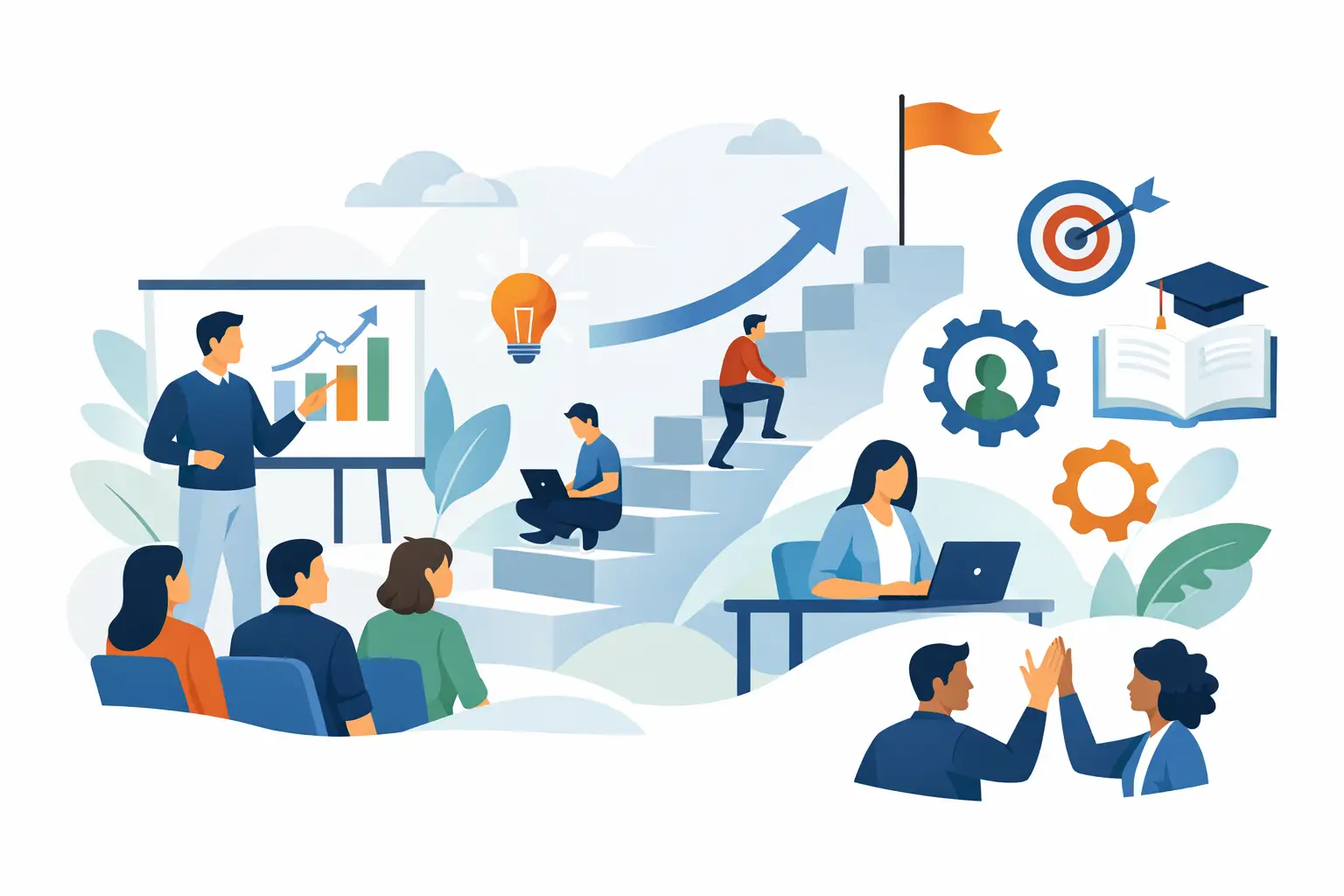
A familiar problem shows up in many organizations: the company invests in training, employees attend, and very little changes in day-to-day performance. The issue usually is not effort. It is design. Effective employee development and training programs are built around business priorities, role requirements, and measurable performance outcomes – not just course calendars.
For HR leaders, consultants, and business decision-makers, that distinction matters. Training that is disconnected from selection data, behavioral fit, leadership expectations, or manager feedback often becomes an expense with weak return. Development programs that are tied to validated insights, however, can improve productivity, retention, bench strength, and decision quality across the workforce.
What employee development and training programs should actually accomplish
At their best, employee development and training programs do three jobs at once. They help employees perform better in their current role, prepare them for future responsibilities, and give leadership better visibility into workforce capability.
That sounds straightforward, but many programs lean too far in one direction. Some focus almost entirely on compliance and task training. Others emphasize leadership content for a small group of high potentials while overlooking frontline performance issues. Neither approach is wrong on its own. The problem is imbalance.
A practical program starts by separating training from development while keeping both connected. Training usually addresses a defined skill or knowledge gap. Development is broader. It addresses behavior, judgment, communication, leadership readiness, and long-term fit with the organization’s needs. If the business needs stronger sales execution, better manager accountability, or deeper succession coverage, the program should reflect that reality directly.
Why many development efforts underperform
The most common failure point is weak diagnosis. Organizations often launch broad learning initiatives before they have a clear picture of what is driving underperformance. If a manager struggles with delegation, is the issue skill, motivation, role overload, lack of clarity, or behavioral mismatch? If sales performance is uneven, is the gap product knowledge, prospecting discipline, coachability, or a poor fit for the demands of the role?
Without that diagnosis, companies tend to prescribe the same solution for everyone. Generic workshops, standard learning paths, and one-size-fits-all leadership programs can create activity, but activity is not the same as improvement.
A second issue is that development is often detached from hiring data. This creates an avoidable blind spot. If organizations already use assessments, structured interviews, reference data, or competency models during selection, those insights should not disappear after onboarding. They should inform development priorities from the start.
A third issue is manager inconsistency. Even strong content loses value when managers do not reinforce it. Employees tend to sustain new behaviors when their manager sets expectations, observes performance, and follows up with useful feedback. When that reinforcement is absent, the effects of training fade quickly.
Building employee development and training programs around validated data
The strongest programs begin with evidence. That includes business metrics, role expectations, manager observations, and assessment data that help explain how employees are wired to perform.
Behavioral assessments can be especially useful here, not as labels, but as decision-support tools. They help organizations understand communication style, pace, decision tendencies, motivators, and likely strengths or risks in a role. That matters because development is rarely just about knowledge transfer. It often involves helping employees adapt behavior under pressure, work more effectively with others, or manage role demands that do not come naturally.
For example, a highly assertive sales leader may need development in listening and coaching. A technically strong individual contributor may need support with influence, conflict management, or team communication before moving into management. A customer-facing employee may need role-specific coaching that reflects both service expectations and behavioral tendencies. The content may look similar on the surface, but the development approach should differ.
This is where validated tools improve decision quality. They help organizations move beyond assumptions and target development with more precision. For consultants and HR teams, that precision also makes it easier to show why a program exists, who it is for, and how progress will be evaluated.
A practical framework for stronger programs
A useful framework starts with the role, not the course catalog. Define what successful performance looks like in the position. That should include skills, behaviors, decision patterns, and performance standards. If the role is leadership-focused, identify the competencies that matter most – such as coaching, accountability, strategic thinking, or collaboration.
Next, compare those requirements with the employee’s current profile. Use available data: manager input, performance history, 360 feedback, assessment results, and any role-specific benchmarks. This step matters because two employees with similar performance scores may need different development plans.
Then design the intervention. Sometimes formal training is appropriate. In other cases, targeted coaching, stretch assignments, manager-guided practice, or peer feedback will produce better results. It depends on the nature of the gap. Knowledge gaps respond well to structured training. Behavioral gaps usually require repetition, feedback, and accountability over time.
Finally, define success before the program launches. If the goal is stronger managers, decide what that means in observable terms. Higher team engagement scores, lower regrettable turnover, better quality of one-on-ones, and improved execution against team goals are all more useful than vague statements about leadership growth.
Employee development and training programs for different talent stages
Not every employee population needs the same experience. Early-career employees usually need faster role clarity, stronger onboarding, and skill-building tied closely to immediate job demands. Mid-level employees often need cross-functional exposure, project leadership, and communication development as they take on broader responsibility. Senior leaders need a different level of support – usually centered on strategy, executive presence, team leadership, and succession impact.
High-potential programs also require caution. Organizations often identify future leaders based on current performance alone. That can be risky. High performance in one role does not automatically predict success in a larger one. Assessment data, feedback patterns, and leadership behaviors should all inform those decisions.
There is also a trade-off between scale and customization. Enterprise-wide programs are efficient, but they can miss role-specific realities. Highly customized development plans are more relevant, but they take more time and manager effort to sustain. The right balance depends on the size of the organization, the criticality of the roles, and the cost of getting development wrong.
The manager’s role in making development stick
No development strategy works well if managers treat it as an HR event. Managers translate learning into performance. They clarify expectations, spot behavior in real situations, and reinforce what good looks like.
That means managers need support as well. If they are expected to coach others, they need a practical coaching framework, clear behavioral language, and enough confidence to have direct conversations. This is one reason 360 feedback and behavioral profiling can be so effective in development environments. They give managers and employees a shared reference point for discussing strengths, blind spots, and growth priorities without relying on guesswork.
Organizations should also be realistic here. Some managers are strong technical performers but weak coaches. If the company expects them to drive employee growth, that capability should be developed intentionally rather than assumed.
Measuring what matters
If a program cannot be measured, it becomes difficult to defend and even harder to improve. Completion rates and participant satisfaction have value, but they are not enough. The more relevant question is whether the program changed performance in a way the business can see.
Useful measures vary by role and objective. Sales teams may look at conversion rates, pipeline activity, or revenue per rep. Operations teams may look at quality, output, or error reduction. Leadership programs may be measured through retention, promotion readiness, team performance, or 360 feedback movement over time.
It is also wise to evaluate whether the original target group was right. Sometimes disappointing results are not caused by weak content. They come from enrolling the wrong people, solving the wrong problem, or expecting training to fix a selection issue. Strong organizations are willing to ask that question honestly.
For companies that want better outcomes across the employee lifecycle, connecting hiring insights with post-hire development creates a significant advantage. Maximum Potential has long operated in that space because the quality of talent decisions improves when selection, fit, and development are treated as part of the same system rather than separate activities.
Where to start if your current program feels scattered
Start small, but start with rigor. Choose one business-critical role or one management population where better performance would create visible value. Define success clearly, identify the behaviors that drive it, and use available assessment and feedback data to build focused development plans.
Resist the urge to launch broad content before doing that groundwork. The most effective employee development and training programs are not the ones with the largest library or the most sessions on the calendar. They are the ones that solve real performance problems with enough precision that leaders can see the difference.
When development is tied to validated data, reinforced by managers, and measured against business outcomes, it stops being a soft initiative. It becomes a better way to build capability, reduce talent risk, and prepare the organization for what comes next.












Leave A Comment