
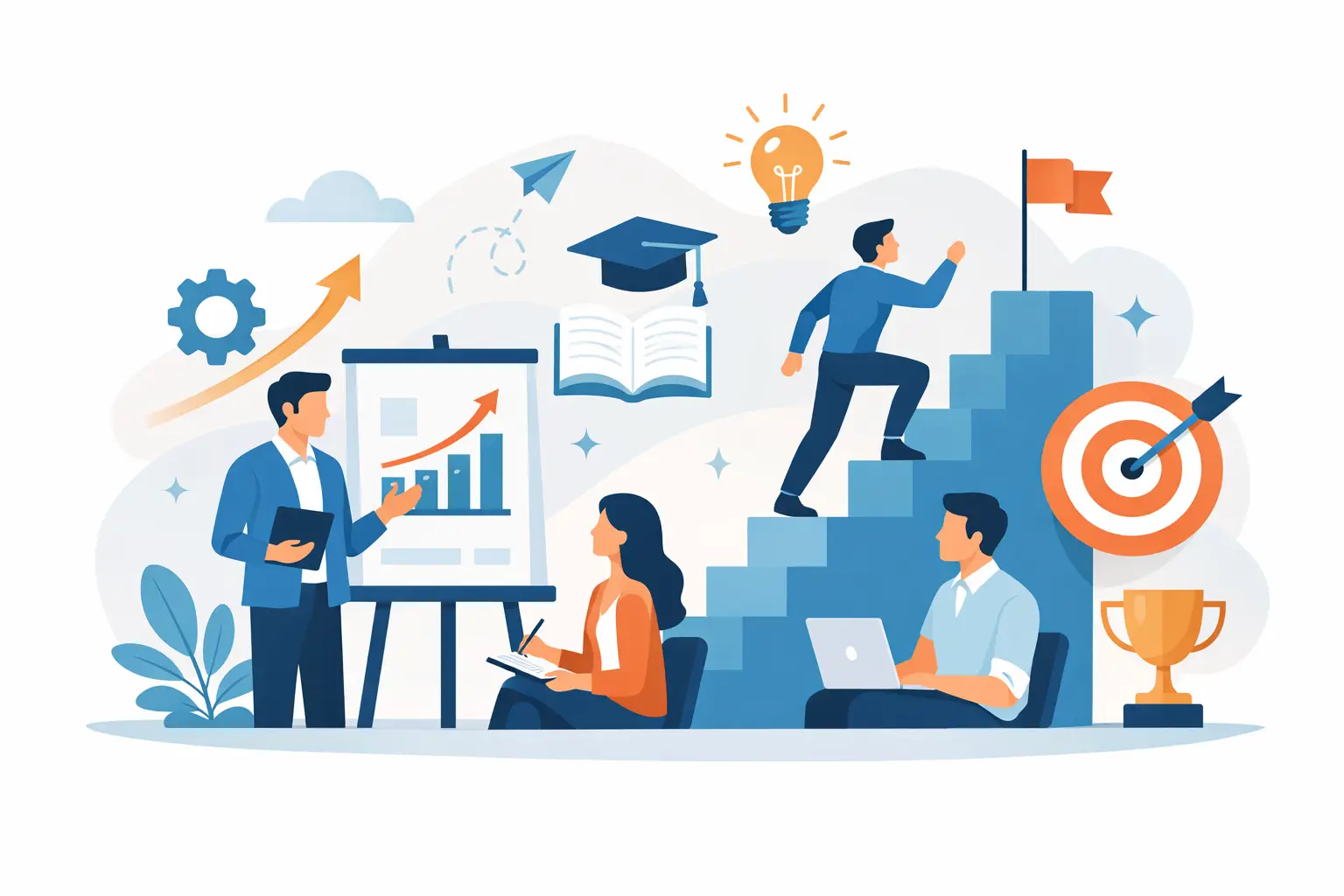
A strong hire can still become an underperformer if the organization stops investing after onboarding. That is why understanding what is employee development and training matters for any company focused on performance, retention, and leadership continuity. The two terms are often used together, but they do different jobs, and organizations get better results when they treat them as related but distinct parts of talent strategy.
What is employee development and training?
Employee training is the structured process of teaching people the knowledge and skills they need to perform their current job effectively. It is usually tied to specific tasks, systems, compliance requirements, sales methods, service standards, or technical capabilities. The goal is immediate job performance.
Employee development is broader. It focuses on preparing people for future responsibilities, stronger decision-making, leadership growth, and long-term contribution to the business. Development often includes coaching, feedback, stretch assignments, behavioral insight, and competency building. The goal is not only better execution today, but stronger capability tomorrow.
Put simply, training helps employees do the job. Development helps them grow beyond the job.
That distinction matters because organizations often overinvest in short-term instruction and underinvest in long-term capability. A company may teach a manager how to complete a performance review form, for example, but never develop that manager’s ability to coach, influence, resolve conflict, or lead through change. One improves compliance. The other improves leadership quality.
Why businesses need both
Companies that separate training from development too sharply usually create talent gaps. Employees may know the process but struggle with judgment, communication, adaptability, or leadership presence. On the other hand, companies that talk about growth without building technical and role-specific skills can create ambition without execution.
The stronger approach is to align both. Training builds consistency, reduces errors, and shortens time to productivity. Development supports succession planning, internal mobility, engagement, and leadership bench strength. Together, they improve decision quality across the workforce.
For HR leaders and organizational consultants, this is not just a people issue. It is an operating issue. Weak training increases mistakes, service failures, and ramp-up time. Weak development raises the cost of turnover, limits promotability, and leaves organizations unprepared when key roles open unexpectedly.
How employee training works in practice
Training is usually easier to define because it has a narrower scope. It often starts with a role requirement or a performance gap. A sales team may need better discovery skills. A manufacturing operation may need safety retraining. A new supervisor may need instruction on scheduling, documentation, or policy enforcement.
Good training is specific, measurable, and connected to business outcomes. It answers a direct question: what should this employee be able to do after this learning experience that they could not do before?
That means effective training should not stop at content delivery. Completion rates are not enough. The real test is whether performance changes on the job. If employees attend training but error rates, productivity, or customer outcomes do not improve, the issue may be with the content, the learner fit, the manager follow-through, or the job environment itself.
This is one reason assessments can play a valuable role. Training outcomes are often stronger when organizations understand how people naturally communicate, solve problems, respond to pressure, or absorb feedback. A one-size-fits-all approach may look efficient, but it often produces uneven results.
What employee development includes
Development is less about instruction and more about capacity. It is often personalized and tied to future potential rather than immediate task execution. A high-potential employee may need stronger strategic thinking. A frontline manager may need to improve delegation. A technical expert moving into leadership may need better communication and self-awareness.
Development can include mentoring, executive coaching, behavioral assessments, 360 feedback, succession planning conversations, leadership programs, and assignments that stretch a person’s current capabilities. In many cases, the most effective development happens through work itself, supported by structured feedback and clear expectations.
This is where many organizations run into a practical challenge. Development is harder to standardize than training, so it can become vague. Employees are told to “grow as leaders” without a clear model of what leadership means in that organization. Managers are asked to coach, but they are not equipped to identify behavior patterns or development priorities.
A more disciplined approach starts with role success profiles, competencies, and validated insights into individual behavior. When development is grounded in actual performance requirements, it becomes more than a general career conversation. It becomes a decision-support process.
The difference between activity and impact
One of the most common mistakes in employee development and training is confusing activity with progress. A company launches workshops, assigns e-learning modules, or rolls out a leadership series, then assumes capability has improved. Sometimes it has. Often, the evidence is weak.
The better question is whether people are performing differently in ways that matter to the business. Are new hires reaching productivity targets faster? Are managers retaining stronger teams? Are future leaders demonstrating the competencies needed for promotion? Are salespeople improving close rates, not just attending sessions?
Measurement does not need to be overly complicated, but it does need to be intentional. For training, this may include time to proficiency, quality scores, quota attainment, compliance rates, or customer satisfaction. For development, it may include internal promotion rates, readiness for succession, engagement among key talent, retention of high performers, and manager effectiveness scores.
If the learning strategy is not tied to business outcomes, it becomes difficult to justify continued investment.
Why employee fit affects development outcomes
Not every performance issue is a training issue. That is a hard truth, but an important one. Sometimes the problem is role fit, manager fit, or a mismatch between a person’s behavioral tendencies and job demands.
An employee who is highly independent may resist a tightly controlled service role. A technically skilled employee may struggle in a leadership position that requires persuasion and emotional steadiness. In those situations, more training may produce only marginal gains because the underlying fit issue remains.
That is why the strongest talent strategies connect pre-hire assessment with post-hire development. When organizations understand a person’s behavioral style, strengths, likely blind spots, and motivators early, they can make better hiring decisions and create more targeted development plans after hire. Maximum Potential has long focused on that connection because better workforce decisions rarely start and stop at one stage of the employee lifecycle.
How to build a stronger employee development and training strategy
A useful strategy starts with business priorities, not learning trends. If the organization needs stronger first-line managers, lower turnover in customer-facing roles, or better sales conversion, those goals should shape the learning agenda.
From there, define what success looks like in each role. That includes technical skills, behavioral expectations, and the competencies that separate average performers from top performers. Without that foundation, training content and development plans tend to be generic.
Next, use structured data wherever possible. Performance reviews alone rarely provide enough clarity. Behavioral assessments, 360 feedback, competency models, and role benchmarks help identify where support is needed and where investment is likely to produce the best return.
Then, match the solution to the need. If the issue is a knowledge gap, training may be the right answer. If the issue is judgment, influence, resilience, or leadership readiness, development is usually the better path. Sometimes both are needed, but they should not be treated as interchangeable.
Finally, involve managers. Even well-designed programs fail when direct supervisors do not reinforce expectations, coach application, or follow up on progress. Learning sticks when managers translate it into day-to-day behavior.
What good looks like over time
A mature approach to employee development and training does not rely on isolated events. It builds a system. Hiring decisions reflect role fit. Onboarding accelerates performance. Training closes immediate skill gaps. Development prepares people for broader responsibility. Feedback and assessment provide course correction along the way.
That kind of system produces practical advantages. Organizations become more consistent in how they evaluate talent. Managers have a clearer language for coaching. Employees see a path for growth that is tied to real expectations, not vague promises. And leadership teams gain more confidence in succession and workforce planning.
The main trade-off is that this approach requires discipline. It takes more than assigning courses or holding occasional workshops. It requires clarity about performance, evidence about people, and a willingness to measure whether the investment is working.
For organizations serious about hiring well and developing talent with purpose, that discipline is worth it. Training helps people perform the work in front of them. Development prepares them for the work the business will need next. The companies that treat both as part of one performance strategy are usually the ones that build stronger teams with fewer costly talent mistakes.












Leave A Comment