
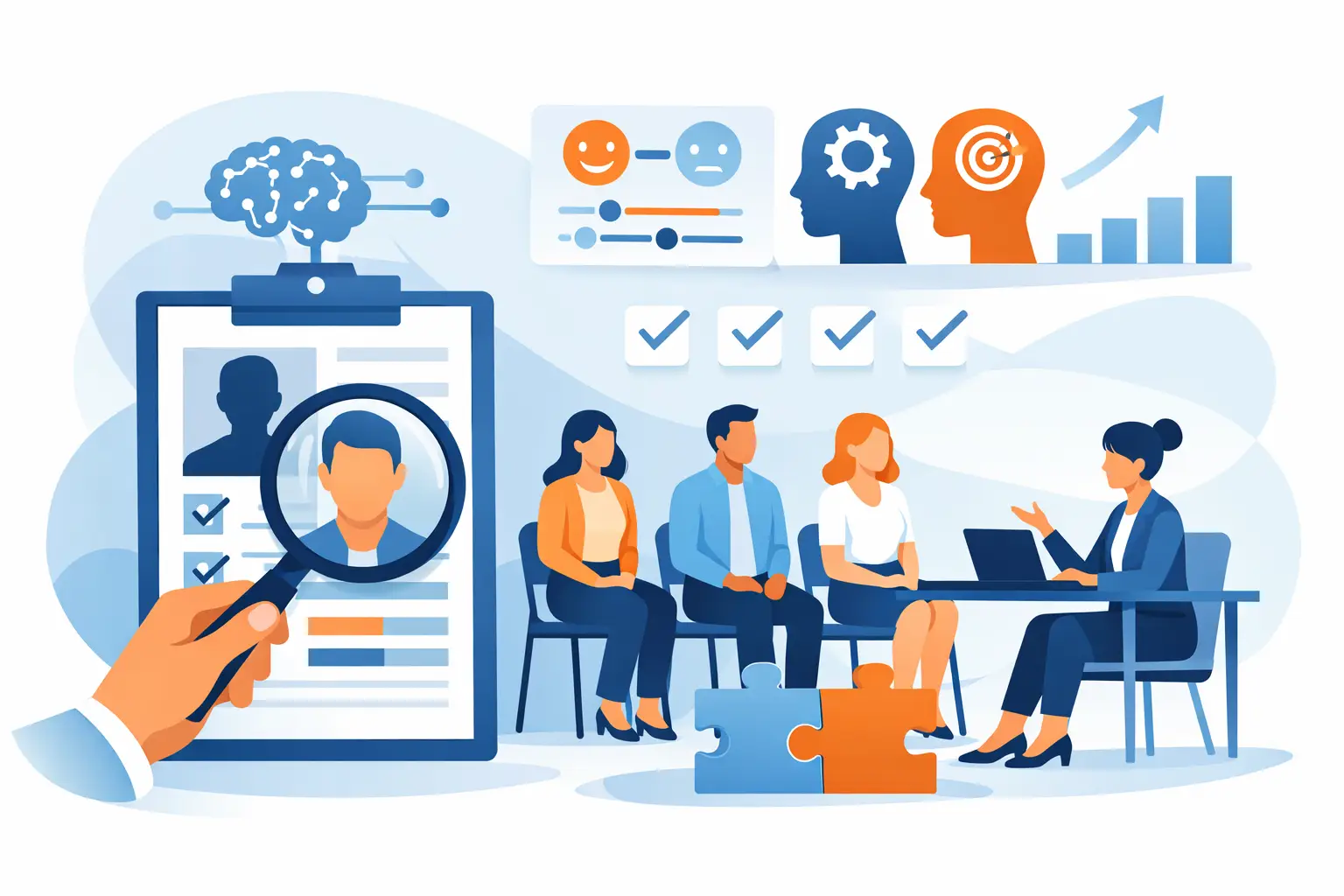
A resume can tell you where a candidate has worked. An interview can tell you how well they present. Neither reliably tells you how that person is likely to behave once the real demands of the job show up. That is where behavioral assessment for hiring earns its value.
For HR leaders, recruiters, and consultants, the issue is not whether behavior matters. It clearly does. The issue is whether you are measuring it in a way that improves decision quality instead of adding noise to the process. A well-designed behavioral assessment helps employers evaluate fit, work style, communication tendencies, and role alignment before a costly hiring mistake becomes a performance problem.
What behavioral assessment for hiring actually measures
Behavioral assessment for hiring is designed to identify consistent patterns in how people tend to respond, communicate, make decisions, and operate in a work environment. It does not measure everything, and it should not be treated as a prediction machine. What it does well is provide structured insight into likely workplace behavior.
That distinction matters. Behavioral tools are not the same as skills tests, cognitive ability assessments, background checks, or reference checks. Each serves a different purpose. A candidate may have the technical ability to do a job and still struggle because their natural pace, communication style, or tolerance for structure does not match the role.
For example, a sales role that requires frequent outreach, persistence, and comfort with rejection places different behavioral demands on a candidate than a compliance role that depends on consistency, detail orientation, and adherence to process. Treating those roles as if they require the same personal style is one reason organizations make avoidable hiring errors.
Why employers use behavioral assessments in selection
Most hiring problems are not caused by a complete lack of qualifications. They are caused by mismatch. The candidate looked capable, interviewed well, and checked the basic boxes, but something was off after hire. They moved too slowly for the pace of the team. They pushed too hard in a collaborative environment. They resisted structure in a process-driven role. Or they required a management approach the organization was not prepared to provide.
Behavioral assessments help surface these issues earlier.
Used correctly, they give hiring teams a more objective basis for discussing fit. They can improve interview quality by showing where to probe. They can also support consistency across managers, which is especially useful when multiple stakeholders are involved in the same hiring process.
The business case is straightforward. Better fit can reduce turnover, shorten ramp time, improve manager confidence, and protect team performance. For organizations hiring at volume, even modest improvements in selection accuracy can produce significant operational value.
What a good behavioral assessment process looks like
A useful assessment process starts with the role, not the test. If you do not know what behaviors are actually required for success, the output will be hard to use and easy to misinterpret.
That means defining the job in behavioral terms. How much initiative is needed? How much structure does the role require? Is the work highly social, highly analytical, highly repetitive, or highly adaptive? What kind of pace, communication style, and decision pattern tends to succeed in that environment?
Once those requirements are clear, the assessment can be mapped against them. This is where validated tools matter. A behavioral profile is only valuable if it is reliable, relevant to workplace performance, and interpreted in the context of actual job demands.
The strongest hiring processes do not use a behavioral assessment as a pass-fail filter by itself. They use it as one part of a decision framework that may also include structured interviews, job-related screening, reference data, and role-specific evaluation. This approach is more defensible and usually more accurate.
Behavioral assessment for hiring is not culture guesswork
One of the most common mistakes in hiring is confusing behavioral fit with personal similarity. Managers often describe fit in subjective terms. They want someone who will mesh with the team, communicate well, or fit the culture. Without structure, those phrases can quickly become inconsistent and biased.
Behavioral assessment for hiring can improve that conversation by replacing vague impressions with measurable dimensions. Instead of saying a candidate feels like a fit, the team can discuss whether the person is likely to thrive in a fast-changing environment, whether they prefer independent work or close collaboration, and whether their style matches the expectations of the role.
That does not eliminate judgment. It improves it. The goal is not to hire the same personality type repeatedly. The goal is to make informed choices about the behaviors that support performance in a specific context.
Where behavioral assessments help most
Behavioral data is especially useful in roles where performance depends heavily on interaction style, pace, resilience, influence, consistency, or adaptability. Sales, customer service, frontline leadership, operations, and management roles often benefit because success in those positions depends on more than credentials.
That said, the value of assessment depends on application. For a simple, high-volume role with short training time and low complexity, an elaborate behavioral process may be unnecessary. For a business-critical role where turnover is expensive and team impact is high, adding a validated assessment is often a sound investment.
This is one of the trade-offs organizations should address honestly. More data is not automatically better. The right amount of assessment is the amount that improves decision quality without slowing the process so much that it hurts hiring execution.
What to look for in a behavioral assessment partner
Not all assessments are built for hiring, and not all vendors support sound implementation. That is where many organizations get disappointed. They buy a tool, receive a colorful report, and still are not sure how to use it in selection.
A credible partner should be able to explain validation, intended use, interpretation standards, and how the assessment fits into a broader hiring workflow. They should also be clear about limitations. If a provider promises certainty, that is a warning sign. Good assessment practice is about better odds, not perfect prediction.
Support matters as much as the instrument itself. Hiring teams need role benchmarking, report interpretation, and practical guidance on translating assessment results into targeted interview questions and selection decisions. For consultants and distributors, that support is also essential for delivering value to clients with consistency and confidence.
Maximum Potential has long focused on this practical side of assessment use, helping organizations connect validated tools to real hiring and development decisions rather than treating profiles as standalone reports.
Common mistakes that weaken results
The first mistake is using behavioral results without job context. A profile is not good or bad on its own. It only becomes meaningful when compared to the needs of the role.
The second is overreliance. Behavioral assessment should inform the hiring decision, not make it by itself. If a candidate appears misaligned on paper but has a strong track record in similar environments, that deserves investigation rather than automatic rejection.
The third is poor interviewer discipline. If managers receive assessment data but continue to run unstructured interviews based on instinct, much of the value is lost. Assessment works best when it sharpens the questions and improves consistency.
The fourth is ignoring post-hire use. The same behavioral insights that support selection can often improve onboarding, coaching, and manager-candidate alignment after hire. When organizations connect pre-hire assessment with post-hire development, the return on the tool usually improves.
Making behavioral data useful to managers
Managers do not need more reports. They need clearer decisions. That means the assessment output should be easy to interpret, tied to job success factors, and useful in plain business terms.
A practical report should help answer questions such as: How is this person likely to communicate under pressure? What kind of environment supports their best performance? Where might they need coaching? What interview questions should we ask before moving forward?
That level of clarity turns behavioral data into something operational. It supports better conversations between HR and hiring managers and reduces the tendency to default to gut feel when candidates are closely matched on experience.
Hiring will never be risk free. People are more complex than any single measure can capture. But that is not an argument against assessment. It is an argument for using the right tools, in the right way, with realistic expectations.
When behavioral assessment for hiring is grounded in validation, tied to role requirements, and integrated into a disciplined selection process, it improves the odds of hiring people who can perform, adapt, and contribute. For organizations trying to hire correctly the first time, that is not extra process. It is better decision support.
The most useful hiring systems do not ask managers to trust instinct less because instinct is bad. They ask them to support instinct with better evidence, so the final decision stands up when performance starts to matter.








Leave A Comment