
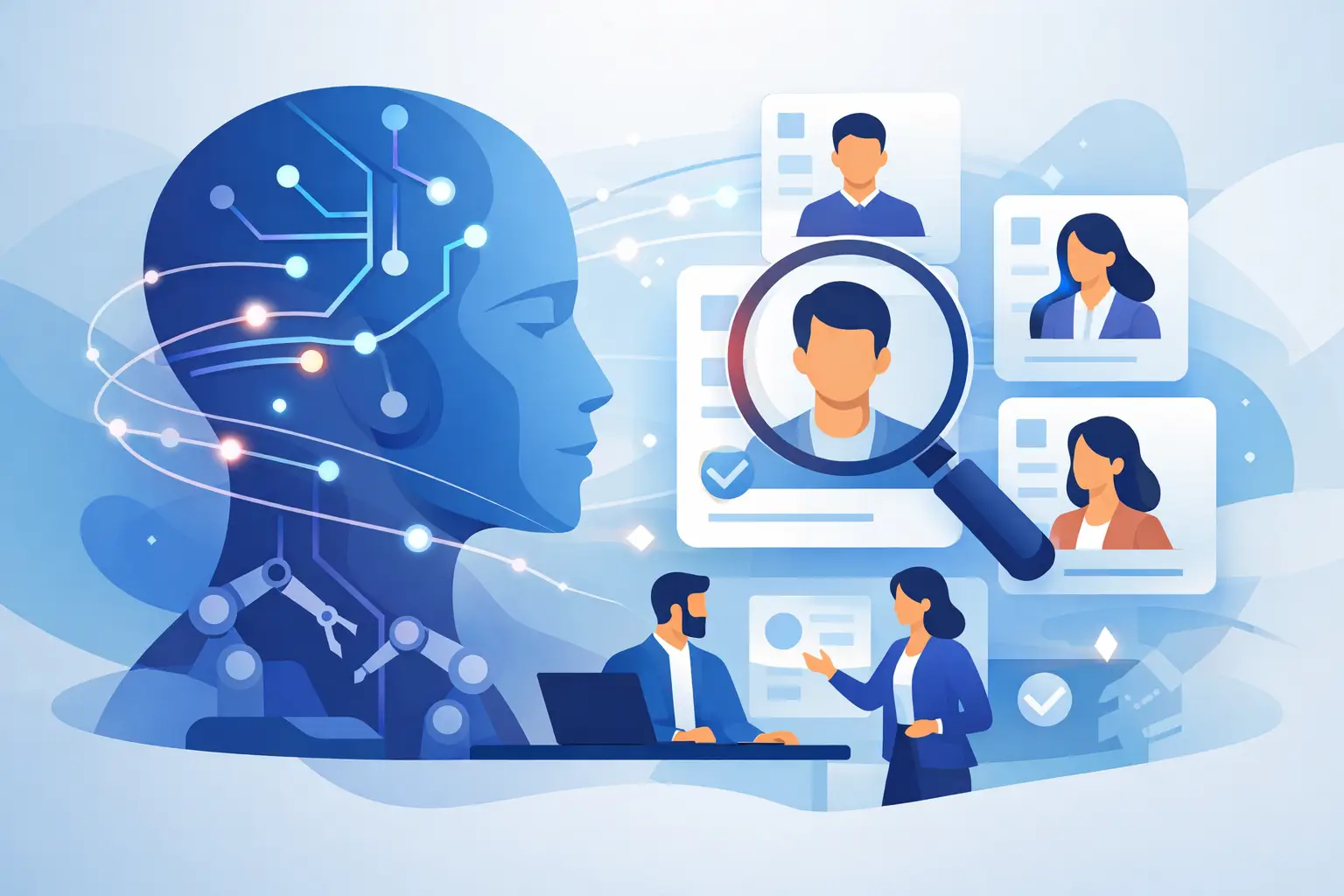
A hiring team can review the same resume and reach three different conclusions. One sees potential, one sees risk, and one sees a close match based on keywords alone. That is exactly where ai powered candidate matching can help – not by replacing judgment, but by making it more consistent, faster, and easier to defend.
For HR leaders and talent decision-makers, the real question is not whether AI belongs in hiring. It is whether the matching process improves decision quality. If the technology only accelerates weak screening logic, it simply helps organizations make bad decisions faster. If it is built on relevant job criteria, validated inputs, and measurable outcomes, it can become a practical advantage.
What ai powered candidate matching actually does
At its core, ai powered candidate matching compares candidate data against job requirements and ranks or recommends applicants based on fit. That may sound straightforward, but the quality of the match depends entirely on what data the system uses and how fit is defined.
Some platforms rely heavily on resumes, job titles, education, and skills language. Others incorporate assessment data, behavioral tendencies, experience patterns, competency indicators, and even historical hiring outcomes. Those approaches are not equal. A matching engine built only on text similarity may be efficient, but it often misses the difference between someone who can describe a role and someone who can perform it well.
That distinction matters in high-cost hiring decisions. A sales role, for example, may require persistence, competitiveness, communication style, and comfort with rejection. A resume may not reveal those factors clearly. A matching process that includes validated behavioral and performance-related data is far more likely to identify candidates who can succeed in the actual environment.
Why employers are paying closer attention to matching quality
Most organizations are not struggling with a lack of applicants. They are struggling with signal quality. Applicant volume is high, recruiter time is limited, and many teams still depend on manual review processes that vary by recruiter, hiring manager, or location.
That creates predictable problems. Qualified people are overlooked because their resumes are unconventional. Marginal candidates move forward because they match surface-level keywords. Hiring managers receive shortlists that look acceptable on paper but do not align with the role’s behavioral or performance demands.
AI can reduce that noise, but only when the system is trained to value the right indicators. Faster screening is useful. Better screening is what produces business value. When candidate matching is aligned to job success factors, organizations can reduce time-to-fill without lowering selection standards.
The strongest use case for AI powered candidate matching
The best use of AI is not broad automation for its own sake. It is structured support for high-volume, repeatable decisions where consistency matters.
That includes frontline hiring, sales recruiting, customer-facing roles, multi-location operations, and positions where turnover or misalignment creates clear financial drag. In those environments, ai powered candidate matching can help standardize first-pass screening, prioritize the most relevant candidates, and reduce the randomness that often enters early-stage hiring.
It is also useful for consultants and talent advisors who need to help clients improve process discipline. A matching tool gives them a repeatable framework, but the tool has to be grounded in more than speed. If a consultant is trying to improve quality of hire, retention, or manager satisfaction, the matching logic must connect to actual role requirements and validated measures.
Where matching systems often fall short
The market tends to talk about AI as if all matching tools are equally intelligent. They are not. Many systems are still built around pattern recognition from incomplete or biased data sets. If past hiring decisions were inconsistent, subjective, or poorly documented, an AI model can reinforce those flaws.
That is one reason organizations should be cautious about black-box matching scores. A high match score means very little if no one can explain what factors drove it. Transparency matters, especially when hiring decisions need to be fair, defensible, and tied to business outcomes.
There is also a difference between correlation and validity. A platform may identify patterns in prior hires, but that does not prove those patterns predict success. Reliable candidate matching should be tied to competencies, behavior, job fit, and performance indicators that have a logical and measurable connection to results.
AI matching works better with validated assessments
This is where many hiring systems improve significantly. When ai powered candidate matching is paired with validated assessments, the matching process becomes more than resume sorting. It starts to evaluate likely fit against the demands of the role.
For employers, that means candidate ranking can reflect factors that matter after the hire, not just before it. Behavioral style, communication tendencies, sales orientation, leadership potential, and job-specific competencies can all strengthen the match when they are measured properly.
For example, two candidates may have similar backgrounds, but one may be far better aligned with the pace, accountability, and interaction style of the role. Without assessment data, those differences may not appear until late interviews or after onboarding. With structured inputs, matching becomes more predictive and less dependent on recruiter intuition alone.
This is also where long-term value shows up. Better matching at the front end supports stronger development planning after the hire. If hiring and development tools operate in the same decision-support ecosystem, organizations gain continuity instead of starting over once an employee joins the team.
How to evaluate an AI matching solution
Most buyers should start with a practical question: what hiring problem are we trying to solve? If the issue is recruiter workload, almost any automation will help. If the issue is bad hires, manager dissatisfaction, weak retention, or poor role fit, the bar should be much higher.
A credible evaluation should focus on the inputs, the logic, and the outcomes. What information is being matched? Are job profiles clearly defined? Is assessment data included? Can the provider explain how the match is generated? Can the organization compare matching results against turnover, performance, or quality-of-hire data over time?
It also helps to examine how the system fits into the broader selection process. AI matching should support decision-making, not compress it into a single score. Recruiters still need structured interviews. Hiring managers still need role clarity. Employers still need screening discipline. Technology improves process quality when it is part of a sound selection model.
Implementation matters more than the demo
Many platforms look impressive in a sales presentation. The real test is what happens after implementation.
If job criteria are vague, candidate matching will be vague. If hiring managers disagree on what success looks like, the AI will reflect that confusion. If recruiters are not trained on how to interpret match results, they may over-trust the system or ignore it completely.
A better approach is to define the role carefully, identify the competencies and behaviors tied to performance, and then configure the matching process around those factors. That takes more work upfront, but it produces cleaner decisions later. Maximum Potential has long emphasized validated assessments and practical decision tools for exactly this reason: better hiring results come from stronger inputs, not just faster software.
The trade-off leaders should keep in mind
AI matching can improve consistency, scale, and efficiency. It can also create false confidence if organizations treat ranking as proof. A candidate who scores well in the system may still be a poor fit for team dynamics, manager expectations, or culture realities that were never defined properly. On the other hand, a candidate with a lower automated score may bring strengths the model cannot fully capture.
That is why the strongest hiring organizations treat AI as decision support, not decision replacement. They use it to narrow noise, improve comparability, and focus human attention where it matters most. The technology is valuable, but only when paired with validated measures, role clarity, and disciplined interpretation.
For teams trying to hire correctly the first time, that is the standard worth applying. The goal is not to make hiring feel more automated. The goal is to make it more accurate, more consistent, and more closely tied to on-the-job success. When ai powered candidate matching is built that way, it becomes a useful business tool instead of another layer of hiring complexity.
As more organizations adopt AI in talent acquisition, the winners will not be the ones using the most automation. They will be the ones using better evidence.












Leave A Comment